
At 7 PM on Saturday April 6, 1946 the Army Day parade was held on State Street and in the jubilant aftermath of the war, all active duty and furloughed personnel were invited to march. Also taking part was the Commodore Perry chapter of the Military Order of the Purple Heart. Following the parade, a ceremony was held in Perry Square during which the Bronze Star was presented to Dr. Joseph M. Faso, recently discharged from the Army with the rank of Major.
The award was given for 27 months of service as Flight Surgeon in the Pacific - on land at Canton Island in the Gilbert chain and Hickam Field in Hawaii and aloft in the Air Transport Command providing surgical care in an airborne operating suite during transport of wounded soldiers.
Dr. Faso was now home at 845 Silliman Avenue, reunited with his wife of 4 years, Marianne, and their 18-month-old daughter, Melanie, who had only known “dad” as a framed picture sitting atop the radio. She remembers being told that she cried when her dad tried to pick her up for the first time adding that he “quickly won her over.”
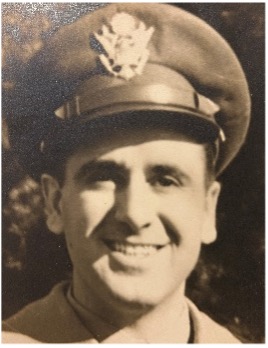
Joseph Faso military photo WWII
Dr. Joseph Faso had served his internship and surgical residency at Hamot Hospital (where he was Hamot’s first surgical resident) before entering the military in 1942. After that service, in 1946, he completed his General Surgical training at Buffalo General Hospital where he taught Anatomy to augment his meager resident income.
Dr. Faso loved surgery and many of the wounded he had treated during the war had complex abdominal wounds, often involving the colon. And so, In August, 1946, the Erie Times-News reported the opening of his surgical office at 251 West 9th Street, “Specializing in Disorders of the Anus, Rectum and Colon.”
From 1948-49, he undertook formal training at Buffalo General Hospital in the specialty then known as Proctology and now known as Colon and Rectal Surgery. In 1954 after a time on the consulting staff at Hamot, Dr. Faso was appointed Chairman of the newly established Section of Proctology at that institution. Membership on the staff of Saint Vincent followed.
Before looking further into the professional career and personal life of this decorated veteran and highly skilled surgeon, it is important to take a step back to his formative years – to his childhood as a first-generation Sicilian-American boy growing up amidst the vineyards in Portland, Chautauqua County, New York.
Roots of the Faso family from Sicily to New York state
In 1960, Attorney Samuel Alessi gave a presentation to the Historical Society in Westfield, N.Y., titled: The Coming of the Italians to Chautauqua County.” He noted that by the end of the 19th century, despite “Risorgimento” that is, the unification of Italy, southern Italy and Sicily, though incorporated into the Kingdom by 1860, remained in abject poverty under harsh repression by the Italian government.
The formerly rich soil of that region had become exhausted. Taxes were oppressive, military training was compulsory, and there were no opportunities for education. It was not surprising that the “barbarians” of southern Italy and Sicily were open to recruitment by agents sent by the United States in the 1890’s to come to America to provide manpower for the explosive economic expansion of that era. And come they did!
As noted by Attorney Alessi, from the 1880’s until the 1920’s, 4.7 million Italians would emigrate to the USA, the vast majority after 1905, including approximately 125,000 Sicilians per year. Mr. Alessi remembered asking a then elderly Sicilian-American why he uprooted his family, leaving “everything and everyone behind” and enduring the anguish and danger of a voyage to the unknown. The gentleman calmly explained that his people were “used to hardships and misery,” but “all that mattered was that they were in America.” He continued in Italian: “Devi porare lo stomaco dove c’e il pane!” (“You have to take your stomach to where the bread is!”)
After arrival in New York City, most of the first Sicilian immigrants settled in Buffalo and Rochester. Then, following family and friends, they moved to smaller cities and towns, notably Fredonia where men found work in the canneries and women and children worked the farms around that village. Migration to Portland, Westfield, Jamestown and Falconer followed. The production of grape wine, beginning around 1894, provided vast new opportunities for farming in the rich soil of western New York.
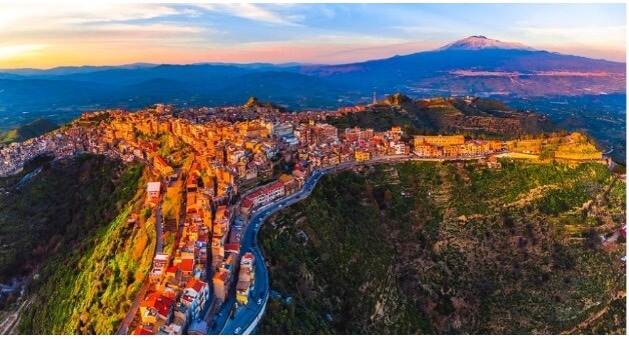
Montemagiorre, Sicily, sat in the shadow of Mount Etna
In 1900, Joseppi Faso Sr., (father of Joseph Martin Faso) emigrated to Portland, New York, from Montemagiorre, Sicily, where he had been born in 1875. He became a naturalized citizen in 1905.
According to Dr. Faso’s daughter, Melanie, everyone in Portland was from that Sicilian town (pictured today) which sat in the shadow of Mount Etna. (Interestingly, the Sicilians who emigrated to the grape farms of Fredonia, New York, 10 miles from Portland, came from Valledolmo, a Sicilian town 10 miles from Montemaggiorre!)
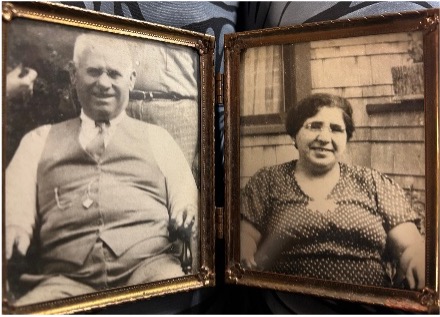
Joseppi and Stephana “Nellie” Faso
In 1904 Joseph married Stephana “Nellie” Miceli, born in Sicily in 1886 and naturalized in 1900. The Federal and New York State Censuses listed Joe’s occupation to be “farmer.” The Welch’s Grape Juice Company had come to Westfield in 1893, drawing upon the abundance of Concord grapes flourishing in the rich and receptive soil of Chautauqua County.
By 1913, grape cultivation was recognized as the most important component of the economy of Portland. Melanie learned that Prohibition, followed by the Depression, saw many local grape growers sell their land. Her grandparents’ farm likely became integrated into the National Grape Cooperative Association, formed in 1956 and now reflecting collective ownership of “670 family-farmers spanning four growing regions across five states."
Joe and Nellie would continue to operate and live in a building attached to the Oasis Bar and Grill - the family-run truck stop on Rt. 5 in Portland (pre-Rt. 20) which stayed in business for years “largely due to Nana’s (Nellie’s) great Sicilian cooking." Joseppi Faso died in 1947 and Nellie in 1953.
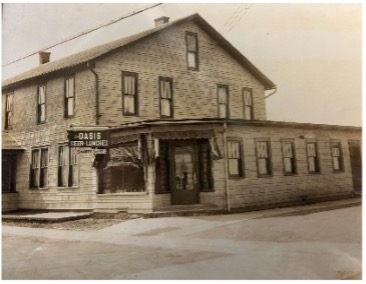
Faso truck stop called Oasis in New York state
Joseph Martin Faso was born on November 11, 1913 in Portland. Melanie notes that her father was called “Pep” from the time he was born—that being the nickname for a boy whose father was Joseppi. Young Pep attended a local public school. He was known for always “fixing things.” There, while spending his entire youth working in his Sicilian family’s vineyard, he proved to be an exceptional student. He earned money bartending at the family truck stop. It is said that young Joe developed an interest in Medicine hearing stories of illness from truckers who stopped at the Oasis for wine and some pasta.
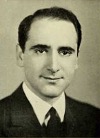
Joseph Faso on graduation day from Hahnemann Medical School (now Drexel University)
Joseph excelled in Biology and Chemistry and, graduating with honors from Westfield High School in 1932, was offered a full scholarship to study at Miami University in Ohio. He paid for other expenses bartending and favoring customers with his clarinet playing. He was invited to attend Hahnemann (now Drexel University) Medical School. There, despite the dual “drawbacks” of his Sicilian heritage and scarcity of resources, Joe Faso was the beneficiary of that school’s long legacy of educating diverse and nontraditional students. He received his M.D. in 1940.
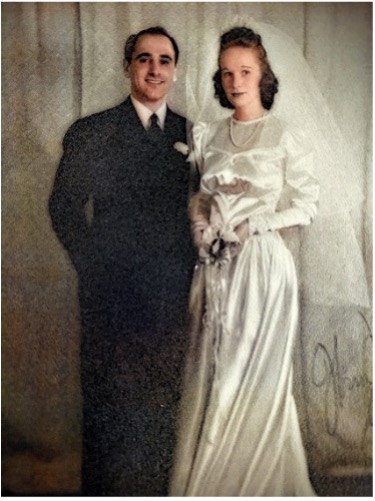
Joseph and Marianne Faso on their wedding day
In a fortuitus encounter (now a common plot line in today’s medical shows) Joe, as a resident at Hamot, met Marianne Gillis, “a red-headed beauty with an amazing smile” who worked as a typist at Hamot. Marianne was a true “coal miner’s daughter” a child of hard-working parents who spent her early life in western Pennsylvania on the West Virginia border. Her father moved to Erie to work as an engineer on the test track that circled the GE plant in Lawrence Park. She graduated from Lawrence Park High School and attended Penn State. Joseph and Marianne were married at Saint Patrick Church on April 25, 1942. Shortly thereafter, he was sent to war.
As noted above, after the completion of advanced training in Proctology, Dr. Faso practiced at 251 West 9th St. (now the site of the parking lot behind Cathedral Prep). There he became associated with Dr. Carl F. Geigle, who had completed Proctology training in Buffalo in 1953.
Drs. Faso and Geigle joined formally in practice as “Proctology Associates of Erie” later that year. In July 1955, the office was relocated to 3216 State Street.
In 1970, Dr. Frank J. Theuerkauf Jr. joined the practice which was renamed Rectal and Colon Surgery, Inc., with specialty services provided to both Hamot and Saint Vincent. Shortly thereafter, Erie took its place as one of only 22 sites around the country which offered advanced Certification in Colon and Rectal Surgery to fully trained General Surgeons.
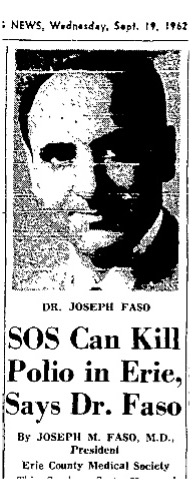 In 1962 Joe Faso was named President of the Erie County Medical Society. Under his leadership the physician community created a “Polio Committee” dedicated to mass immunization of the youth of Erie with the Sabin Oral Polio Vaccine. Despite the success of the Salk Vaccine and the immunization program of 1957, many children in Erie remained unvaccinated. The Sabin Oral Vaccine serum (SOS) was administered orally on a sugar cube in a manner better suited to mass immunization. Working in the intestine. SOS had the added advantage over the shot of stopping spread among children.
Dr. Faso reminded the fearful and skeptical of “the moral obligation to take the serum, not only for concern for personal safety but out of consideration for others, especially children.” He could report on September 24, 1962 that, in one day, 118,000 doses had been administered in “the greatest display of public cooperation” he had ever seen.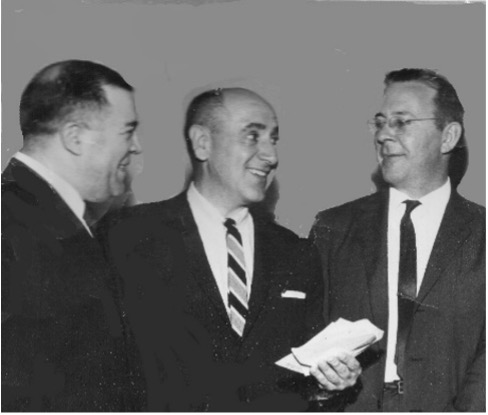
As the stature and reputation of the group surgical practice on State St. grew, Dr. Faso was singularly revered for the comforting and reassuring compassion, the “human touch” he brought to the care of his patients. His generosity was legendary. In the early years of practice he had accepted a variety of forms of payment, “including tubs of lobsters, a slot machine, a pinball machine, and boxes of hand-embroidered pillowcases” from patients who couldn’t afford to pay in any other way. He never sent multiple bills to patients, “believing with his whole heart that people would pay if they could.”
Though the epitome of the first-generation American dreamer, Joseph remained fiercely proud of his Sicilian heritage. Dr. Jim Pepicello notes that, after some persistence, Dr. Faso became the first Italian-American member of the Kahkwa Club.
During the many years of surgical practice, Joe and Marianne raised three children settling in the (then) red-brick, former home of Erie artist Eugene Iverd on Gordon Lane in Glenwood. Their eldest, Melanie (Barnard), inspired by her father, devoted her life to medicine, receiving her Bachelor’s in Nursing from Pitt with a career as an RN and, then, as an EMT (on the ambulance for 18 years).
Along the way she became a nationally recognized cook, appearing on TV and publishing over 15 cookbooks and culinary guides, including, not surprisingly, “The AMA Family Health Cookbook.”
Joe and Marianne’s son, Joseph, likely inspired by stories of his father’s airborne experiences, became a commercial pilot. Their daughter Mary, inheriting her father’s love of teaching, became a Special Needs educator. Melanie’s children and grandchildren have traveled to Sicily to visit family and commune with their roots.

Faso home on Gordon Lane in Erie
In the story of the young Italian-American boy laboring in the Portland Vineyards, there are elements common to the millions of stories, played out over more than 200 years, that make up our nation of immigrants: opportunities to be seized, challenges to be overcome, the support of families and the generosity of our nation in offering and cultivating the Dream.
To the vineyard dreamer, it was an honor to serve his family and his patients. It was an act of devotion to serve his country as a flight surgeon. The hazard of that duty was realized decades later when, in December 1981, at age 68, Dr. Faso succumbed to a brain tumor felt to be attributable to inadequate wartime protection from the radiation emitted by X-ray units on land and in the sights of the enemy in the air.
Marianne Faso died in 2007 at age 86.
To her faither’s life, Melanie offers a simple yet powerful eulogy: “He spent his entire life being grateful for the privilege of being an American from a Sicilian immigrant family.”
About the author: John C. Reilly, M.D., had the privilege of training with Dr. Faso in 1978, being asked to join him in the practice in 1979. Sadly, he never had the opportunity to work alongside this splendid surgeon who became ill and was forced to leave practice later that year.
Dr. Reilly has been writing blogs for the History Center since 2024. He has captured and shared the memories and accomplishments of Erie County’s physicians in addition to other topics. Dr. Reilly is a member of the Erie County Medical Society.
