
On Thursday morning, September 25, 2014, I settled into my office chair to give ear to a story that an unfortunate patient of mine wanted to share with me. I say “unfortunate” because, after undergoing surgery, radiation, and chemotherapy for colon cancer two years before, he had recently required more than one operation for brain tumors. He had been forced to confront the sad realization that, at age 45, his tenacious fight for life was nearing an end.
The story he had to tell was the story of his life, his youthful fascination with trains, his proud rise to the title of Stationmaster serving Union Station for Amtrak and the “trials and tribulations” that accompanied but never dragged down the joy of that realization of dreams. He shared copies of some photographs that commemorated his journey.
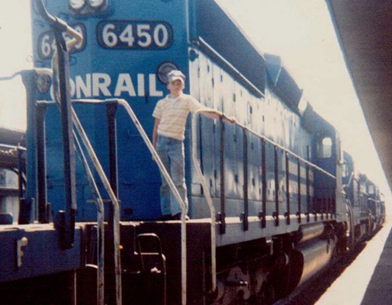
Steve Regruth told me that his father began bringing him down to Union Station on a regular basis beginning in 1971 when he was only 2 years of age. His dad had never worked on the railroad but he wanted to share his fascination for trains with his son. “Who would imagine in 1980, when my dad took this picture of me on the Conrail train, at 11 years of age, that I would serve as Stationmaster here for 13 years?”
In 1971, when Amtrak took over passenger rail routes, the formerly grand station became empty except for Conrail freight offices. With a decline in rail passenger traffic, Amtrak stopped selling tickets in Erie (1984). In 1991, Conrail, relegated to a few offices, sold the city-block long Union Station to a developer who moved the passenger waiting room to the small “express area” of the building, its current location. As noted by Steve, “the former Rotunda/Waiting room became a restaurant/banquet hall, and the concourse was blocked off and cut in half.” The concourse leading to the platforms was once 24 feet wide and when all was said and done, Amtrak got a 10-foot-wide hall leading to the remaining platform #1. With the downsizing, Amtrak replaced stationmasters with caretakers charged with caring for the waiting room and getting passengers on the one eastbound and one westbound train during what came to be, essentially, a night shift.
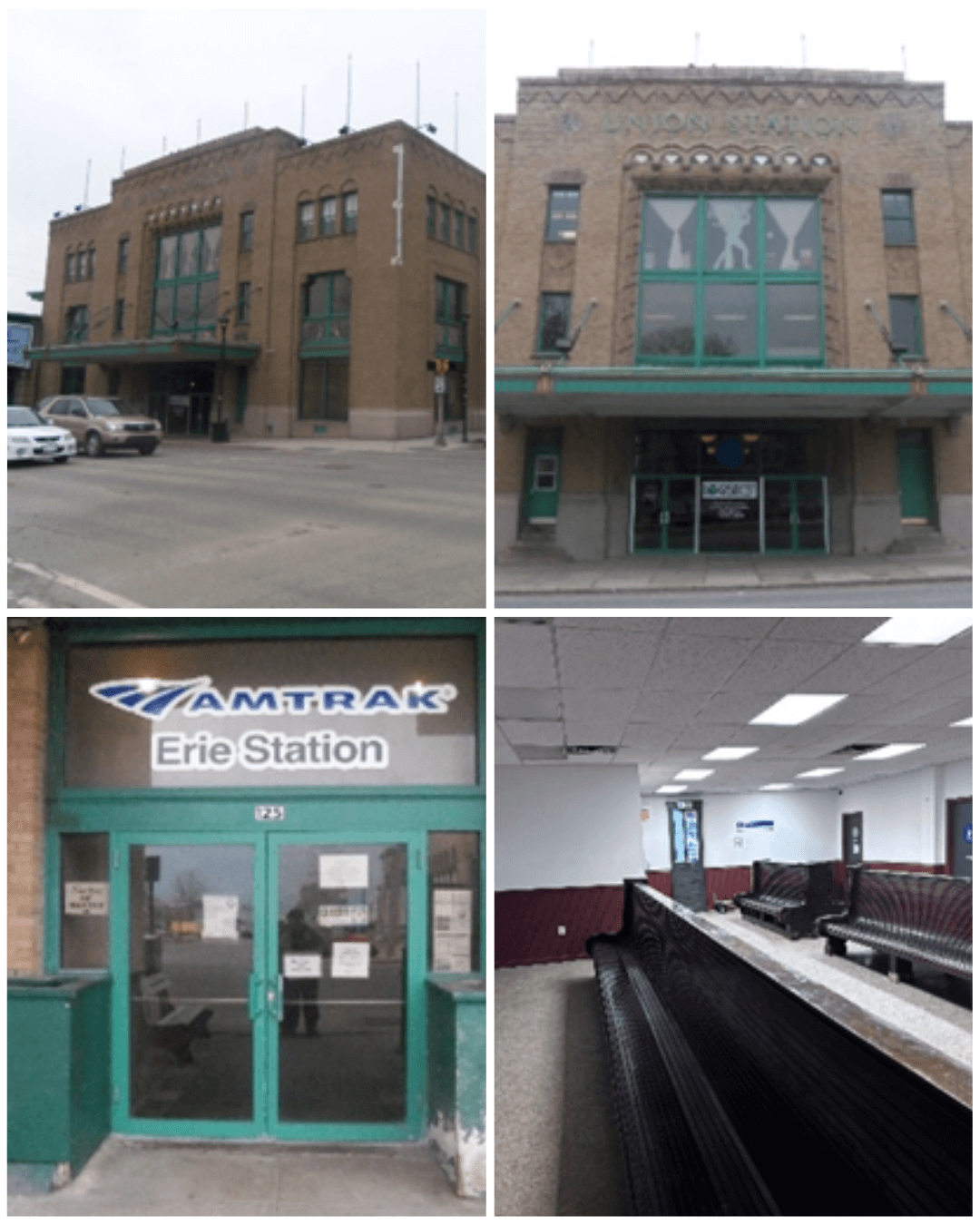
“In the summer of 1987 while working with a local railroad museum (which had sponsored a train ride originating at the Erie Union Station on the old Pennsylvania line) I first met Bart Bartlett, the Union Station Caretaker.” Over the years Steve hung out at the station with Bart who “saw something in me” and began to view Steve as his replacement. Bart had heart trouble and on January 2, 1999, he passed away.
Steve learned that he was to be Bart’s replacement. There would be “ups and downs” to his dream job but, “in the end, it was my job, my life and no matter what happened, I feel that I was meant to be there.”
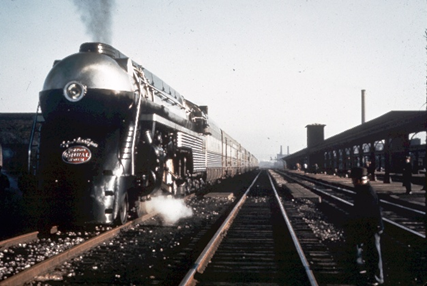
 In his new role, Steve “suffered through” several waves of renovation to the station and platforms, projects which he described in painful detail, noting that, in his view, the work was often done “on the cheap” and incompetently. Escaping the chaos of reconstruction, Steve dedicated himself to sprucing up the waiting room and providing congenial and professional service to the now sparse train-traveling public. And, as with the origin of his fascination for trains, Steve attributed his interest in preserving the history of train travel in Erie to a desire to commemorate his father’s rail travel in World War II. Steve’s dad had told him that, as a teenager visiting his aunt who was working at the now long-gone Railroad Hotel (NE corner of 14th and Sassafras St.) he heard about “a new train visiting Erie” He walked over and checked out the new streamlined “Empire State Express”. The date of the event and the photo below: December 7th, 1941!)
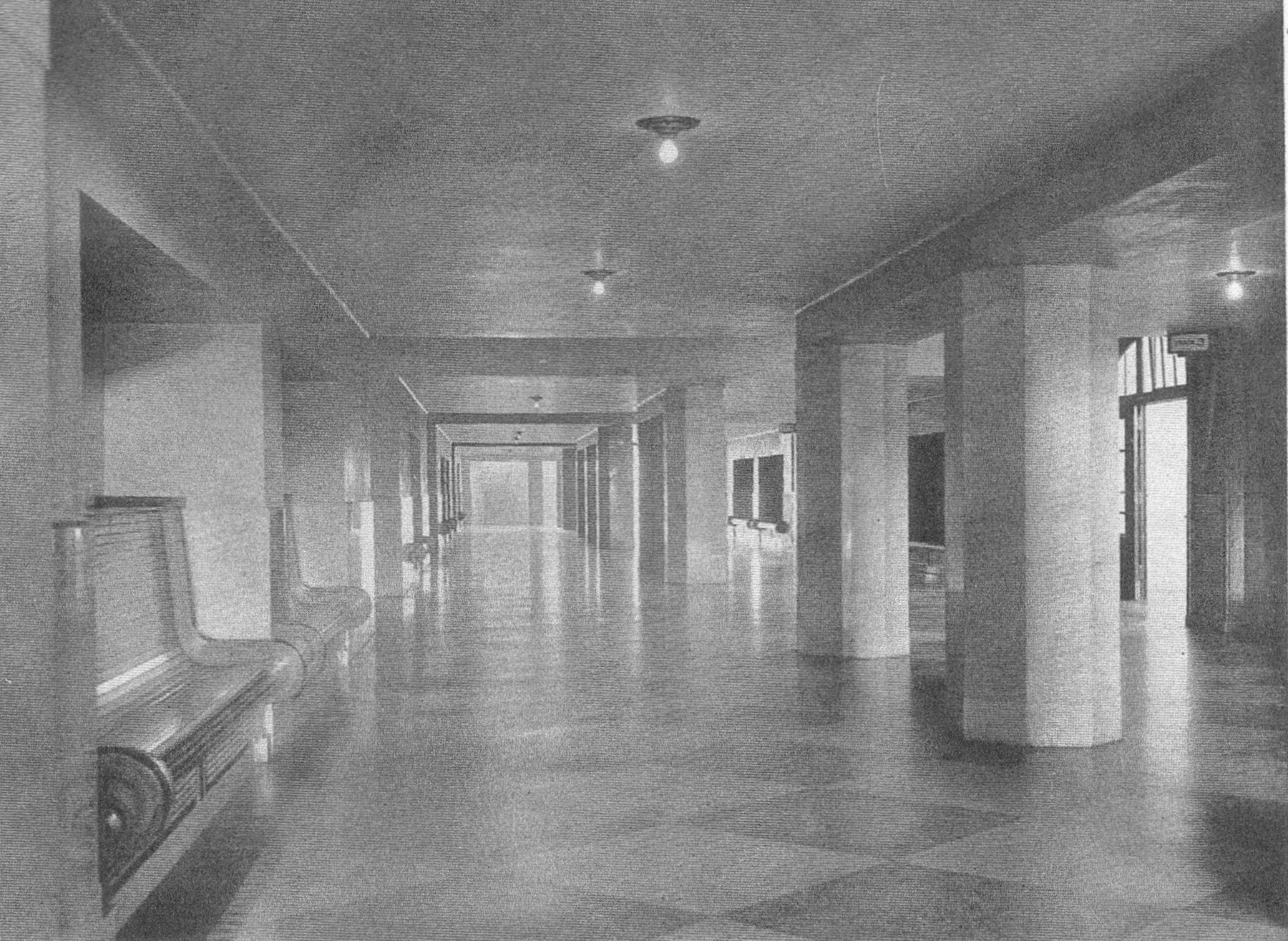
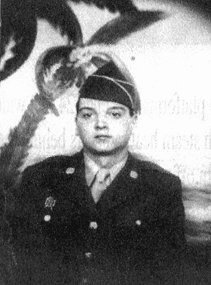
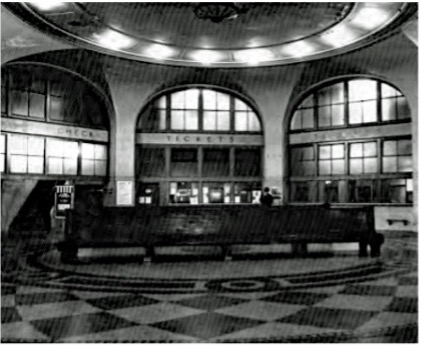
This picture of the 24-foot-wide concourse leading to the tracks was taken just before the Station opened in 1927. Note the benches lining the left wall, behind which were steam heat radiators. Steve related that in 1944 his father, age 18, sat on one of these benches waiting for the train to take him to boot camp. He went out on the Pennsylvania Railroad and came back in 1946 on the New York Central. Steve’s predecessor and mentor Brad Bartlett had the foresight to preserve two of the benches from the concourse which live on in the small Amtrak waiting room. Steve liked to believe that his father had sat on one of the rescued benches on his way to war. He noted that the other benches were used in alcoves for the new restaurant set to occupy the rotunda. Steve lost his father in 2003.
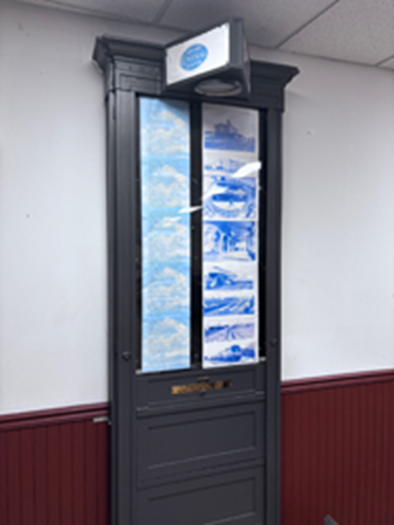
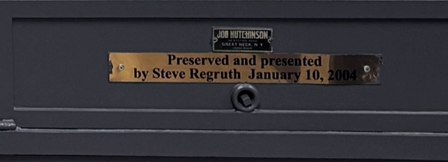
Looking closely at the 99-year-old black and white photograph of the concourse, one can barely make out a “train indicator board” on the extreme right edge of the photo, under a ceiling light. This board notified travelers of the track on which a train would arrive and depart. Steve salvaged that board and it sits today in the waiting room near the entrance to the hallway to the track. The emblems of the two railroads providing passenger service in the 40’s sit above a glass case in which Steve arranged a photographic tribute to the history of Union Station. Today, a plaque below the board commemorates the preservation efforts of Stationmaster Steve.
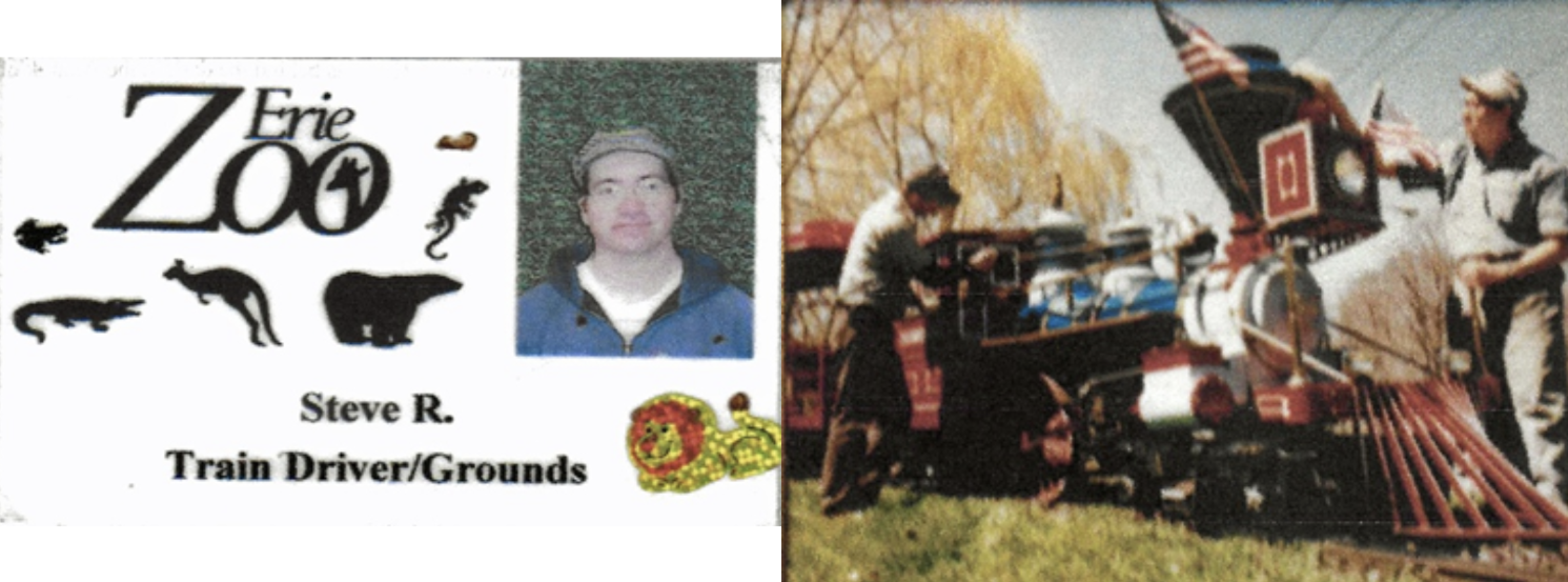
The new millennium found Steve settled in as Stationmaster and furthering his life’s dreams beyond the walls of Union Station. He returned to service as Engineer of the Erie Zoo Railroad in 2006. He described having treated “upwards of 1,000 riders per day” to the leisurely ride. (The ID and Times News Photo – Steve on the right - are from his first stint in 1997.)
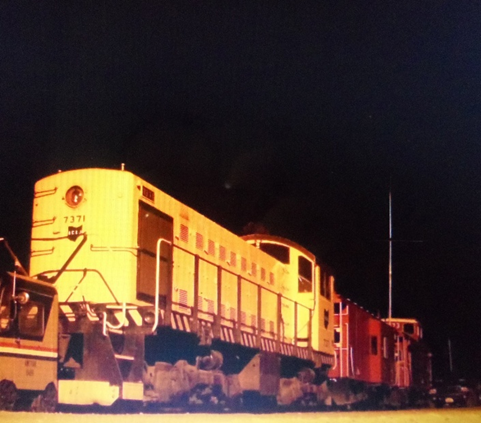
In 2007, Steve secured a third job as a brakeman on the Ashtabula, Carson and Jefferson (AC&J) Railroad out of Jefferson, Ohio. Getting a feel for the throttle and studying the quirks of the “Alco S1 First generation (1941) Diesel (below), he accumulated the 80 hours of throttle time required to take the written exam such that in February 2009, he realized his dream of becoming a licensed locomotive engineer. He delighted in the “honor” of “sitting in the right-hand seat” of that historic locomotive running freight and passengers in “any and all kinds of weather.”
Steve had everything under control as Stationmaster/Caretaker and had decorated his office (which still serves the caretaker in the northwest corner of the waiting room) with photographs of the many trains that had stopped in Erie over the decades. Things had been under control until one night in November 2008, when they weren't. That night, after clearing the platform of snow, he was in the process of directing 20 or so passengers up to the train, when he noted a young man still sleeping on a bench in the waiting room cradling an electric guitar. The man awoke suddenly and announced that he was “goin’ to Vegas” and needed to purchase a ticket. Being told that one could not purchase tickets on site, he got rowdy and intimidating and as Steve retreated to his office to call the police, the man began beating him over the head with his guitar, “swinging it like a baseball bat.” Suddenly and mercifully and for no apparent reason, the assailant bolted out of the waiting room.
Never having lost consciousness, Steve was able to call the police. He gave the dispatcher a brief description of the incident, noting that although he had no idea where the guy went, “you can’t miss him – he is carrying a RED ELECTRIC GUITAR!” When the police arrived, they already had the perpetrator in tow. They had found him about two blocks away “complete with the red electric guitar and my blood splattered on his jacket.”
Steve required reconstructive surgery for a left orbital/sinus fracture. At trial, the assailant received a lengthy sentence.
Recovering from the assault and realizing his dream of becoming a licensed engineer, Steve had to face new serious challenges. “My mom’s and my heath started to go downhill.” His mother’s breathing problems propelled her to the ICU with increasing frequency and she passed away on October 4th, 2011. At the same time, Steve was noted to have been losing weight, a development he initially attributed to the stresses of working while caring for his mother. His regular passengers were telling him that he did not look well. He overheard someone speculate “I wonder if he has cancer.” On May 29, 2012, he required emergency abdominal surgery after which he was told that, as feared but long denied, he had advanced colon cancer. That day his life “took on a whole new meaning” marking the abrupt end to his service as “Amtrak Stationmaster at Erie, PA Union Station.” Radiation and chemotherapy followed but by October he learned that his condition was terminal. His dignity was inspiring to all. Steve died on January 8th, 2015.
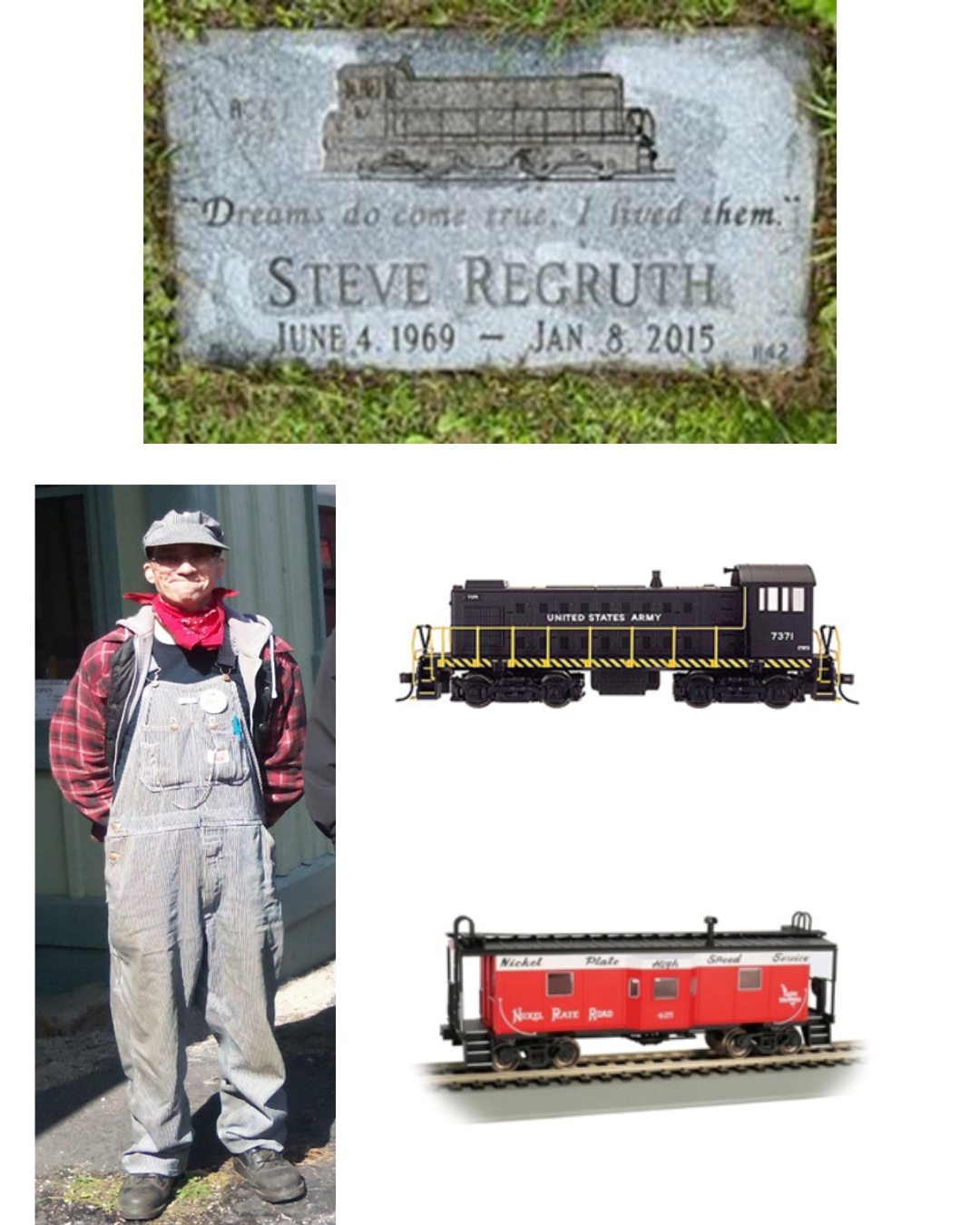
At the end of our conversation four months earlier, Steve outlined his plans for his tombstone. It would feature an engraving of the side of the AC&J 1941 Alco S1 # 7371, the locomotive in which he realized the “dream of becoming a federally certified engineer.” It would bear his chosen epitaph, “DREAMS DO COME TRUE, I LIVED THEM."
Steve arranged with his cousin that he would be buried with the “HO” Scale model of the Alco # 7371, in US Army colors, along with an “O” Gauge” model of the Nickel Plate Road “High Speed Service” Caboose # 425 – “the same one that I slept in for my career on the Ashtabula Carson and Jefferson Railroad.”
As Steve left my office that day, he turned and announced: “On to a better life!” I was left to marvel at what future glory he must have envisioned as a man who in life, sitting before me, had given witness to the blessing of having lived out his dreams.
In late 2025, preparing Steve’s story, I visited the Amtrak waiting room at 8 a.m. – shortly after the eastbound passengers had departed. I ran into a youthful “Caretaker” and asked if I could check out the many framed photographs and the HO scale model trains that I understood from Steve, had decorated the office. I was told that during a repainting of the waiting room 2 or 3 years before, Amtrak had stripped away all memorabilia, including Steve’s father’s picture which he had hung next to the indicator board. Thankfully, the board, itself, remained. The young caretaker had no idea what happened to Steve’s precious items. When asked about his predecessor Steve Regruth, the man with the name on the plaque under the board, he remembered him as the “guy who had been beaten over the head with an electric guitar.”
About the author: John C. Reilly, M.D., has been writing blogs for us since 2024. He has captured and shared the memories and accomplishments of Erie County’s physicians in addition to other topics. Dr. Reilly is a member of the Erie County Medical Society.
